Probing the Local Atomic Structure of Lead Borate Glasses with X-ray Absorption Spectroscopy
Coe College · Georgia Tech · NM Tech · Iowa Glass Conference 2023 · Funding: NSF REU #1950330 & RUI #2203142
Abstract
Borate glasses are widely used in a variety of applications, including optical lenses, electronic devices, and biomedicine. However, the local atomic structure of these glasses is not fully understood, which can limit their performance. X-ray absorption spectroscopy (XAS) is a powerful technique for studying the atomic-scale structure of materials, and it is being used here to study borate glasses.
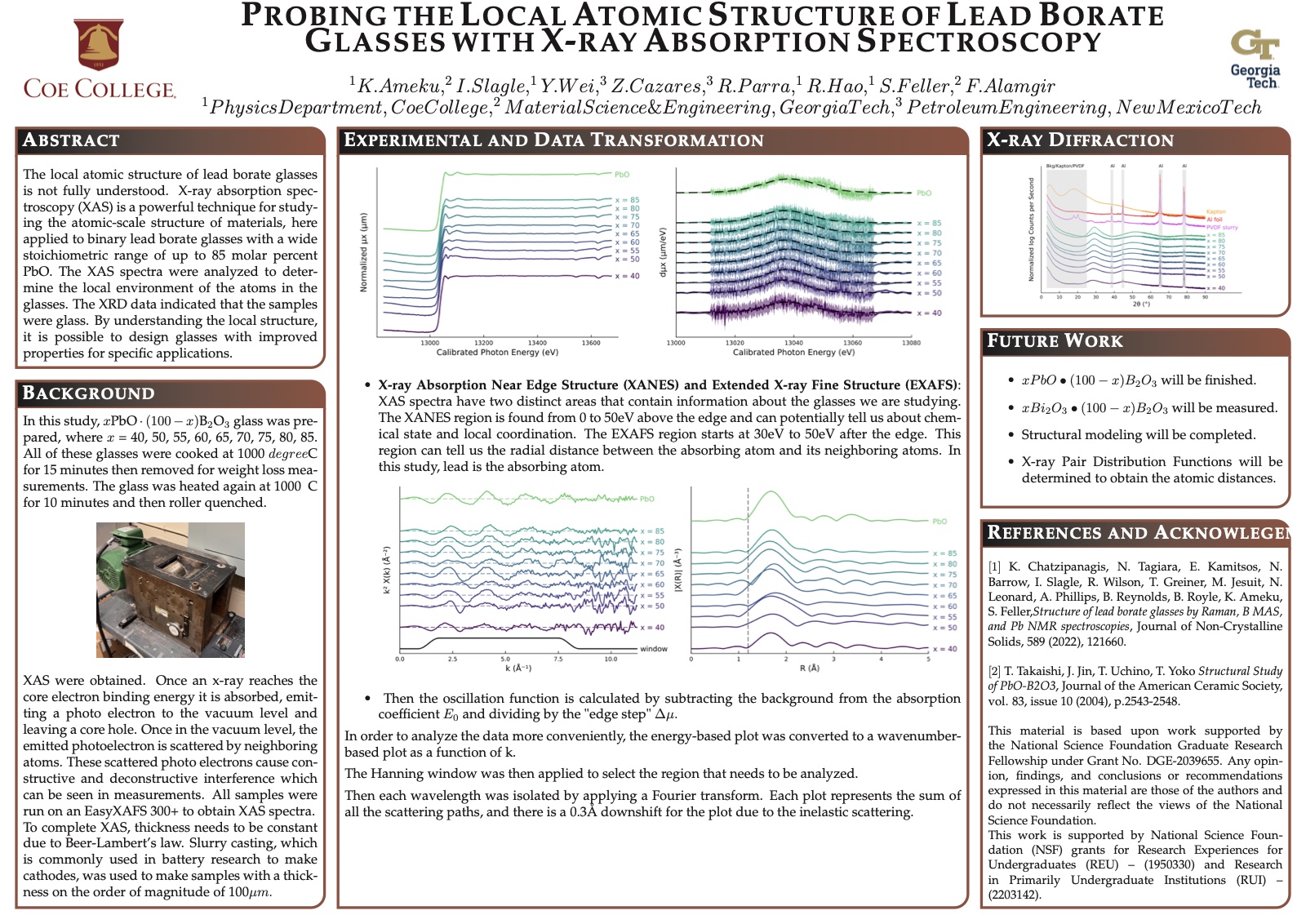
Samples of glass were prepared with widely varying metal oxide to B₂O₃ ratios and were then subjected to XAS measurements. The XAS spectra were analyzed to determine the amorphous structure and local environment of the atoms in the glass. The crystalline peaks in the XRD data for the B₂O₃-based glasses are likely due to the aluminum foil used to mount the samples — the crystalline peaks of the aluminum foil line up with the crystalline peaks in the glass data. This is consistent with the results of the XAS study, which showed that the local structure of the B₂O₃-based glasses is amorphous.
By understanding the local structure, it is possible to design glasses with improved properties for specific applications. For example, glasses with a more disordered local structure may be more resistant to crystallization, which could improve their optical properties.
Supported by National Science Foundation (NSF) grants for Research Experiences for Undergraduates (REU) — #1950330 — and Research in primarily Undergraduate Institutions (RUI) — #2203142.